Here is the thing nobody writing these guides will admit.
They have not actually used most of what they are recommending. They have read other lists, reshuffled the order, added a bit of science-adjacent language, and published it. You can tell because the advice is identical across dozens of sites and completely disconnected from what actually happens to real skin.
I am not doing that here.
My name is James. I run mud ritual sessions in Ibiza and across the UK through Maya Sacred. I have personally worked with bentonite, Dead Sea mud, moor mud, rhassoul, and volcanic ash on hundreds of people with different skin types, different sensitivities, and different goals. I know what each one does because I have watched it do it. I know what goes wrong because I have seen that too.
What follows is the honest version. The one I give to people before their first session when they ask me which mud they should actually use.
Why the Type of Mud Is the Most Important Decision You Will Make got Best Mud For Mud Bath
Most people treat this as a minor detail. They assume mud is mud. That assumption is why so many people have one bad experience and write the whole practice off.
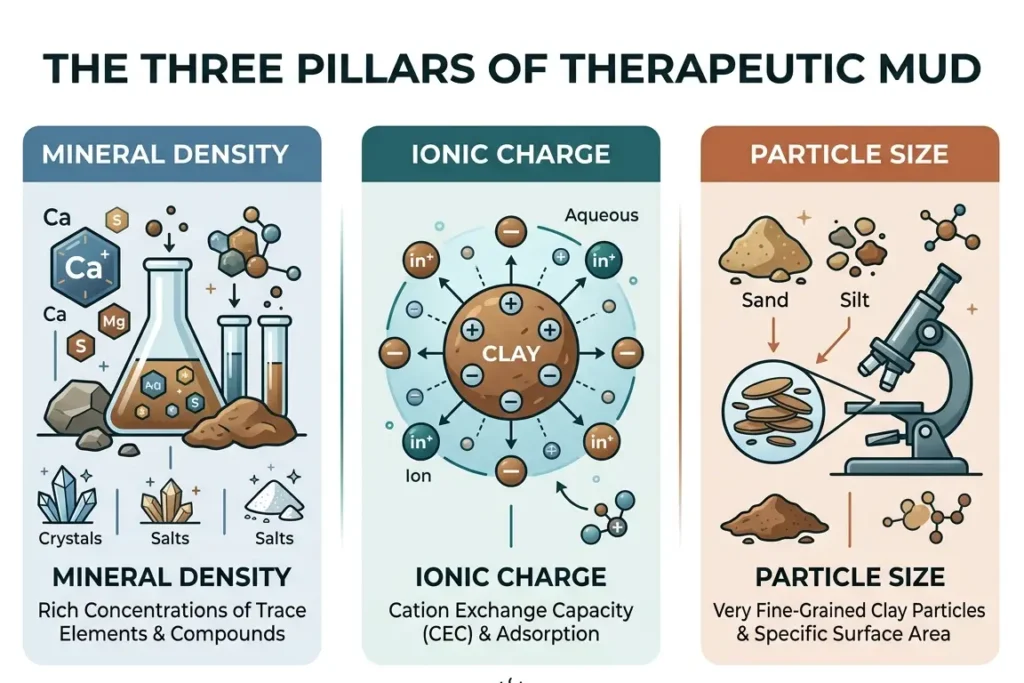
Three things determine whether a mud is therapeutically valuable or an expensive mess.
Mineral density. Muds that form in volcanic regions, ancient seabeds, and geothermal springs carry mineral concentrations that accumulate over geological timescales. Magnesium, calcium, potassium, silica, sulphur. These absorb directly through skin into tissue. That absorption is why a properly sourced mud bath does something a plain warm bath cannot. You feel the difference in your joints. In the weight of your limbs afterwards. In the way your skin looks the following morning.
Ionic charge. This sounds like marketing until you look at the actual chemistry. Bentonite and similar clays carry a strong negative electrical charge. Toxins, environmental residue, and congestion in your pores carry a positive charge. The clay acts as a magnet. The tightening you feel as it dries is a real electrochemical exchange happening at the surface of your skin. It is not the mud just drying out. It is doing what it is supposed to do.
Particle size. Finer particles exfoliate gently, sit comfortably on reactive skin, and rinse clean. Coarser particles do deeper mechanical work but can strip sensitive skin of its barrier in a single session. This is why rhassoul feels completely different from bentonite even though both are technically clay. Same category, completely different effect.
Understand these three things before you choose and everything else in this guide makes sense on its own terms.
7 Best Types of Mud for Mud Baths, Ranked From Personal Experience
1. Bentonite Clay
The one I reach for most often in group sessions, because it performs consistently across more skin types than anything else on this list.
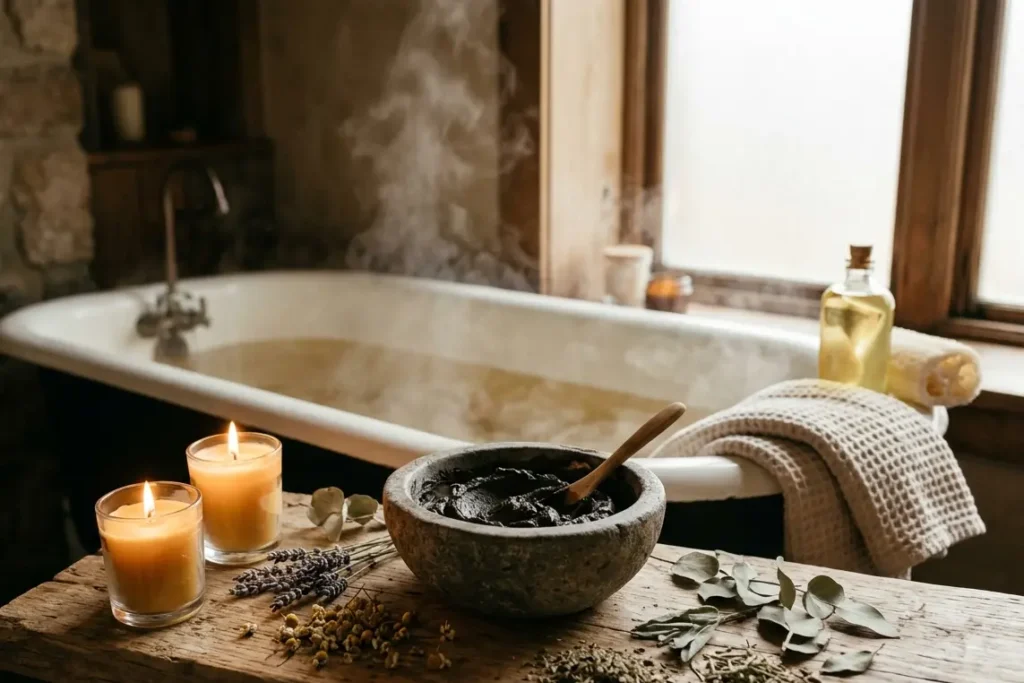
Bentonite forms from volcanic ash that has been mineralising underground for millions of years. Its negative ionic charge is the strongest of any commonly available clay. That charge is what makes it exceptional at drawing out impurities, excess oil, and congestion. It works on contact. You feel it working. The tightening as it dries is the ionic exchange happening in real time.
One rule that is non-negotiable and which I tell every person at every session: no metal utensils. Metal carries a positive charge. It neutralises bentonite’s ionic activity before the clay reaches your skin. Wooden spoon, non-metal bowl, every single time. I once had someone tell me their mud bath had done nothing for three separate sessions. We talked through their process and they had been mixing in a stainless steel bowl. When they switched to ceramic, the difference was immediate.
Best for: Oily and acne-prone skin, full-body detox baths, anyone new to therapeutic clay
How to use: Equal parts clay and water, non-metal bowl, wooden spoon. Apply evenly, wait 15 to 20 minutes, rinse with warm water, apply body oil immediately.
Price in the UK: £6 to £12 per pound
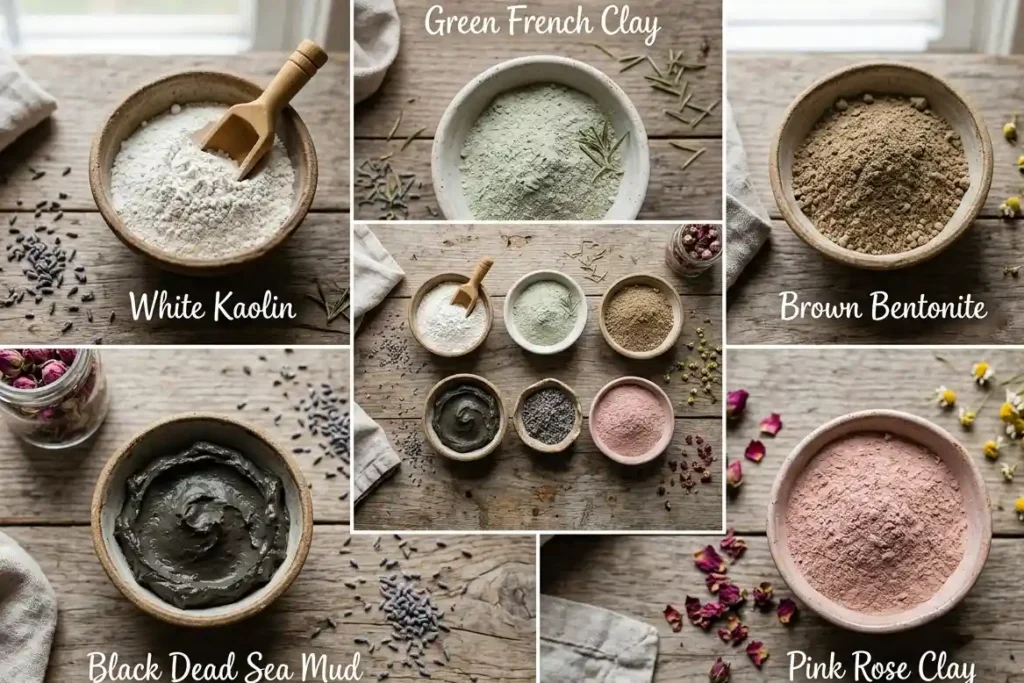
2. Dead Sea Mud
Cross-cultural, multi-millennium therapeutic use does not happen by coincidence. The ancient Romans used Dead Sea mud. Egyptian records reference it. Every serious spa tradition in that region has been built around it for thousands of years. That kind of sustained, widespread use across different cultures and time periods is evidence of something real.
The Dead Sea sits at the lowest point on Earth. Natural evaporation over millennia has concentrated minerals there at levels that genuinely cannot be found anywhere else. Magnesium, calcium, bromide, potassium, in amounts that actively repair the skin barrier, reduce inflammation, and restore hydration in ways that no standard clay can approach.
The clearest distinction I can offer from my own sessions: bentonite is a drawing clay. Dead Sea mud is a feeding clay. When someone arrives visibly depleted, with skin that is tight, reactive, and exhausted from months of stress or aggressive products, Dead Sea mud is the one that makes an immediate visible difference. I have had people ask me the following week what we used because their skin had changed that noticeably after a single application.
For a full breakdown of how Dead Sea mud performs on specific skin conditions, our piece on Mud Bath for Skin: Detox, Glow and Heal Naturally covers that in proper detail.
Best for: Dry, sensitive, inflamed, or mature skin; skin that feels depleted rather than congested
How to use: Apply a generous, even layer. Leave 15 to 20 minutes. Rinse with warm water.
Price in the UK: £12 to £25 for a properly sourced tub
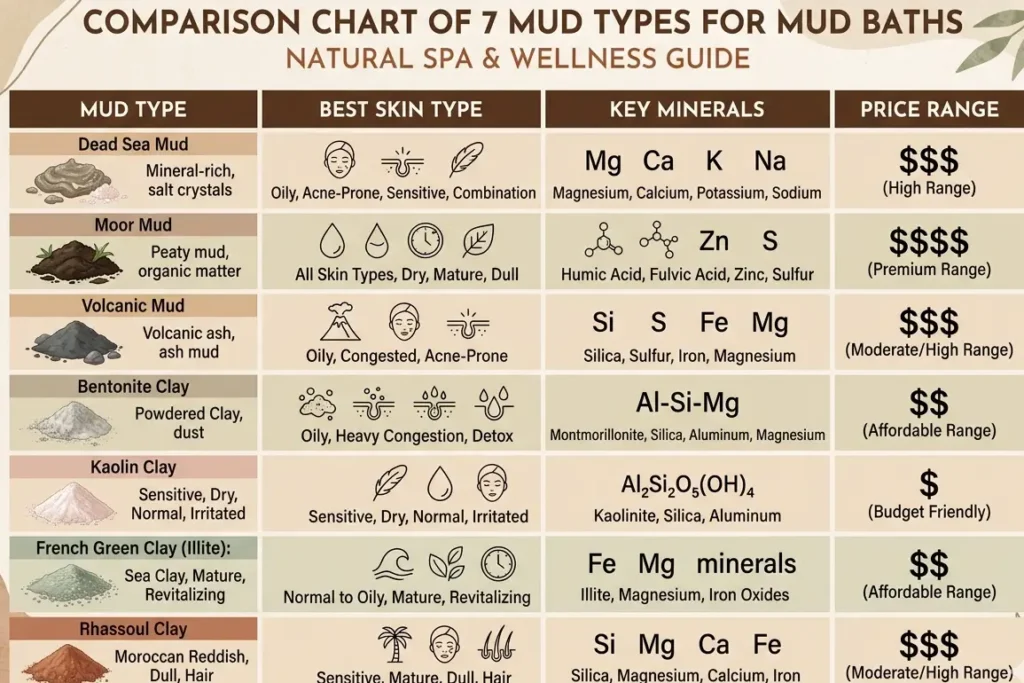
3. Moor Mud (Peat Mud)
This is the one that most consistently surprises people. They expect a skin treatment. What they get is something that works at a completely different level.
Moor mud is not clay. That matters. It is thousands of years of decomposed organic matter: mosses, wildflowers, herbs, plants, breaking down slowly in lowland bogs until what remains is dense in humic acids, fulvic acids, vitamins, and trace minerals that cannot be sourced this way from anywhere else on Earth.
The thermal properties are in a category of their own. Moor mud holds heat deep into muscle and joint tissue. Not surface warmth. Deep warmth. That is why serious European balneotherapy has been built around it for over two thousand years. Austrian and Hungarian thermal spas still use it as their primary therapeutic material today. The ancient Celts documented its use for joint pain. The Romans built entire bathing facilities around it. Two millennia of consistent results across different cultures is not tradition for tradition’s sake.
I use moor mud specifically for sessions where someone is carrying months of accumulated physical tension. Joint stiffness that has not responded to anything else. The residue of chronic stress sitting in the body. The improvement after a single session is usually enough that people ask to book another within the week.
Best for: Joint and muscle pain, poor circulation, physical and emotional recovery, accumulated tension, all skin types
How to use: 2 cups dissolved in a hot bath, soak for 15 to 20 minutes, rest lying down for at least 30 minutes afterwards. The rest window is not optional with moor mud. It is when most of the effect actually lands.
Price in the UK: £20 to £45 or more depending on source purity
4. Rhassoul Clay (Ghassoul)
Mined exclusively from the Atlas Mountains in Morocco and used in Hammam culture for over 1,400 years. Not a trend. A material with genuine cultural depth and a mineral profile that stands completely apart from every other clay.
The particle structure of rhassoul is finer than any other clay in this list. That fineness is everything. It cleanses without stripping. It exfoliates without a single abrading sensation. The softness it leaves on skin is the thing people most struggle to describe when they come back from their first session using it properly. It is not subtle.
Research has confirmed what Hammam tradition already knew: rhassoul improves skin elasticity and reduces dryness without triggering the reactive tightening that stronger clays cause. For people who have had difficult experiences with clay in the past, rhassoul is consistently where things start going right. Mixed with rose water instead of plain water, the experience of applying it stops feeling like a treatment and starts feeling like what it actually is: a ritual that has been refined over fourteen centuries.
Best for: Sensitive and dry skin, anyone with difficult skin history, gentle full-body exfoliation, facial clay work
How to use: Mix with warm water or rose water to a workable paste. Apply for 10 to 15 minutes, rinse gently.
Price in the UK: £10 to £20 per pound
5. Kaolin Clay (White Clay)
Kaolin is the most misread clay on this list. People see mild and assume it is for people who cannot handle the real thing. That misses the point entirely.
For very reactive, dry, or mature skin, the issue with stronger clays is not that they fail to work. It is that they work too aggressively. They draw moisture along with impurities. They strip a skin barrier that already needs support, not more stress. Kaolin cleanses without touching deeper moisture levels. It absorbs surface oil gently. For that skin type, kaolin is not the lesser option. It is the precisely correct one.
Pink kaolin, sold sometimes as rose clay, adds gentle toning and mild circulation support. It also produces a genuinely beautiful bath. A pale blush tone, a soft clay scent. I mention the aesthetics deliberately because a ritual that you look forward to is one you will actually keep doing. That matters as much as the chemistry.
Best for: Very sensitive, dry, or mature skin; anyone for whom stronger clays have previously caused problems
How to use: Mix with water, aloe vera gel, or rosewater. Apply for 10 to 15 minutes.
Price in the UK: £6 to £14 per pound
6. French Green Clay
French green clay takes its colour from decomposed kelp and algae in the quarries where it is mined. That same organic matter gives it genuine antibacterial and anti-inflammatory properties. Not added in. Naturally occurring.
It sits precisely in the middle of the intensity spectrum on this list. More clearing than kaolin, more measured than bentonite. It handles combination skin particularly well because it targets oil and congestion without stripping the drier areas. For post-sun skin or anyone prone to seasonal flare-ups, it is one of the most practical clays to have in your kit because of how well it calms inflammation.
Best for: Combination and acne-prone skin, post-sun inflammation, oil balancing across changing seasons
How to use: Mix with water or cooled green tea. Apply for 15 minutes, rinse.
Price in the UK: £8 to £18 per pound
7. Volcanic Ash Mud
Calistoga, Sulphur Springs, El Totumo. People fly to these places and pay significant amounts of money specifically for volcanic mud bathing. Not for a skin treatment. For an experience that nothing else replicates.
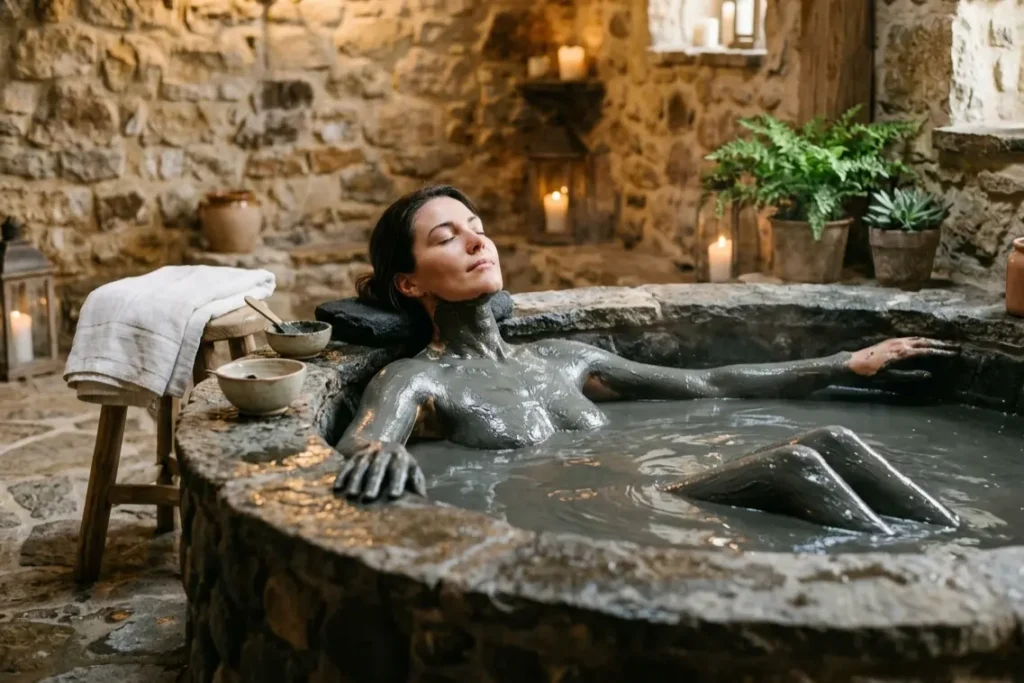
Volcanic ash mud is denser, heavier, and warmer than any clay-based option. The sensation of submersion in it is qualitatively different. The floating feeling people always describe at volcanic spa destinations is a physical property of the density, not a marketing description. The warmth it holds penetrates in a way that surface heat from water alone does not.
I will not tell you a home version is the same as Calistoga. It is not and saying otherwise would be dishonest. The live mineral saturation of active volcanic ground cannot be replicated domestically. But volcanic ash powder mixed with very hot mineral water produces genuinely different skin results from standard clay and comes closer to that immersive physical experience than anything else you can set up at home.
Best for: Full immersive experience, deep detoxification, serious physical restoration
How to use: Volcanic ash powder mixed with very hot mineral water in a large tub. Soak for 10 to 15 minutes.
How to Choose: The Decision Framework I Use With Every Client
Match your primary goal and you will not go wrong.
Detoxification is the priority: Bentonite. The ionic charge does what nothing else does at this price.
Skin repair and sustained hydration: Dead Sea mud. The mineral density actively feeds and restores.
Muscle and joint recovery: Moor mud. Humic acids, fulvic acids, and unmatched heat retention together make it the most physically restorative material on this list.
Exfoliation without any risk of irritation: Rhassoul or kaolin. Real results, none of the intensity.
Acne and oil control: Bentonite or French green clay. Both absorb sebum and clear pores effectively.
The most complete sensory experience: Volcanic ash mud. Nothing else comes close.
Blending is worth doing deliberately. Bentonite with Dead Sea mud gives you detox draw alongside mineral nourishment in one application. Adding kaolin to either softens it for reactive skin. Professional spa formulations are almost always combinations, and there is a reason for that.
If you are weighing up whether to start at home or come to a professional session first, the honest comparison in Mud Bath Spa vs Home Ritual: Which Is Actually Worth It? will settle that question properly.
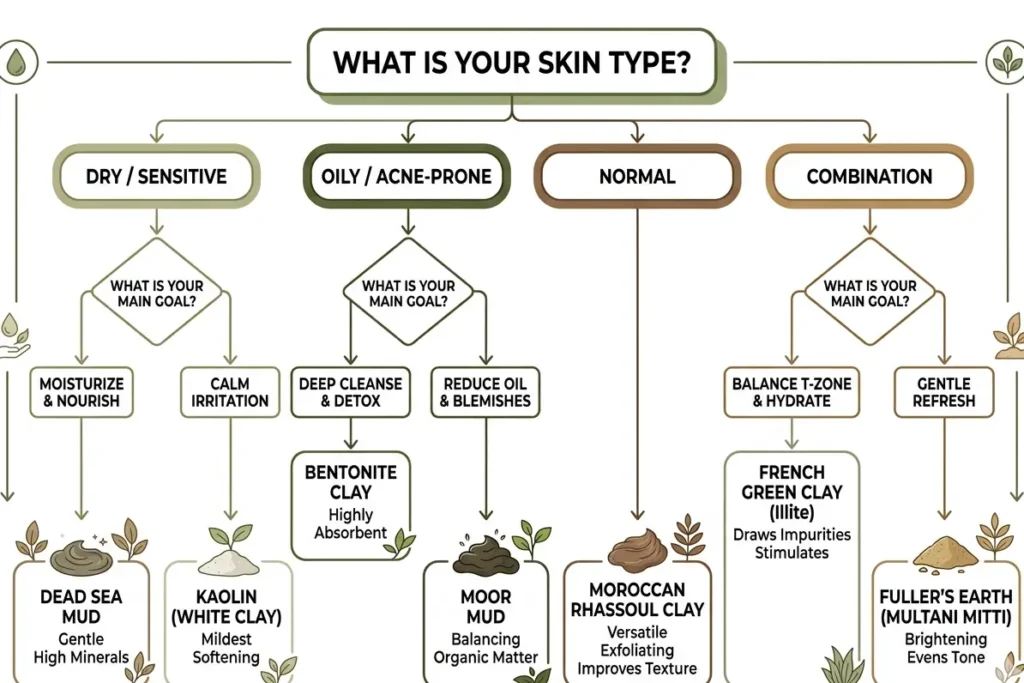
Image: how-to-choose-mud-for-mud-bath-flowchart.jpg Alt text: Flowchart showing how to choose the best mud type for a mud bath based on skin type and wellness goals
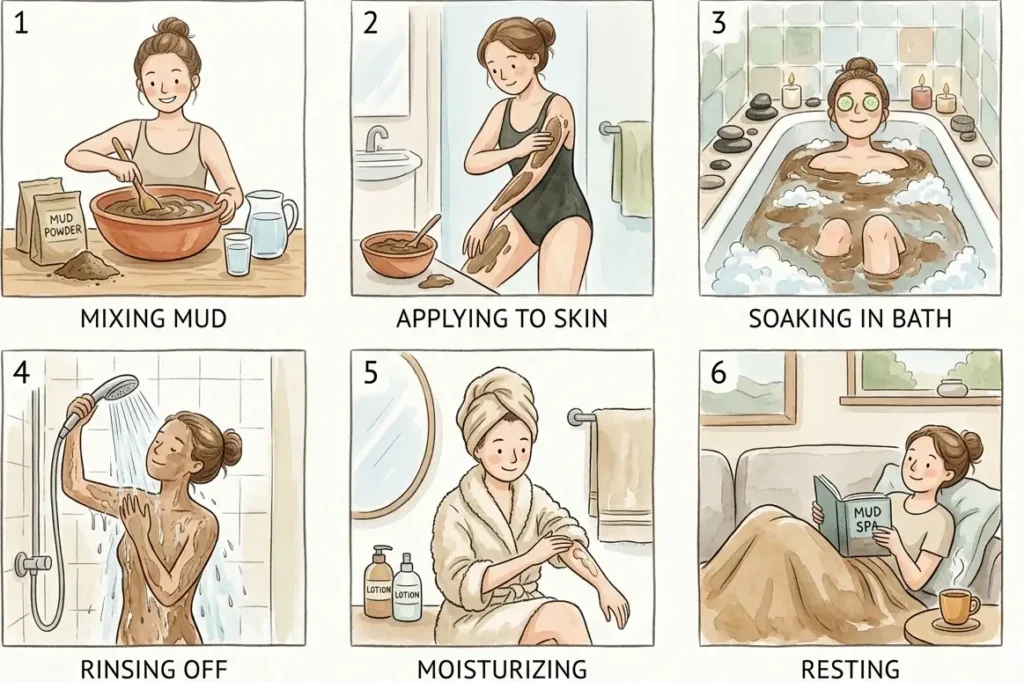
How to Do a Mud Bath at Home
Full ritual setup, space preparation, water additions, and what to do in the rest window are covered in our Mud Bath at Home: Your Step-by-Step Ritual Guide. The core process:
Step 1. Gather everything before you start. Around 2 cups of your chosen mud, a non-metal bowl and wooden spoon if using bentonite, warm water, a dedicated towel, body oil for immediately after.
Step 2. Mix to a smooth, consistent paste. Equal parts mud and warm water. Thicker for skin application, slightly looser for dissolving into a full bath.
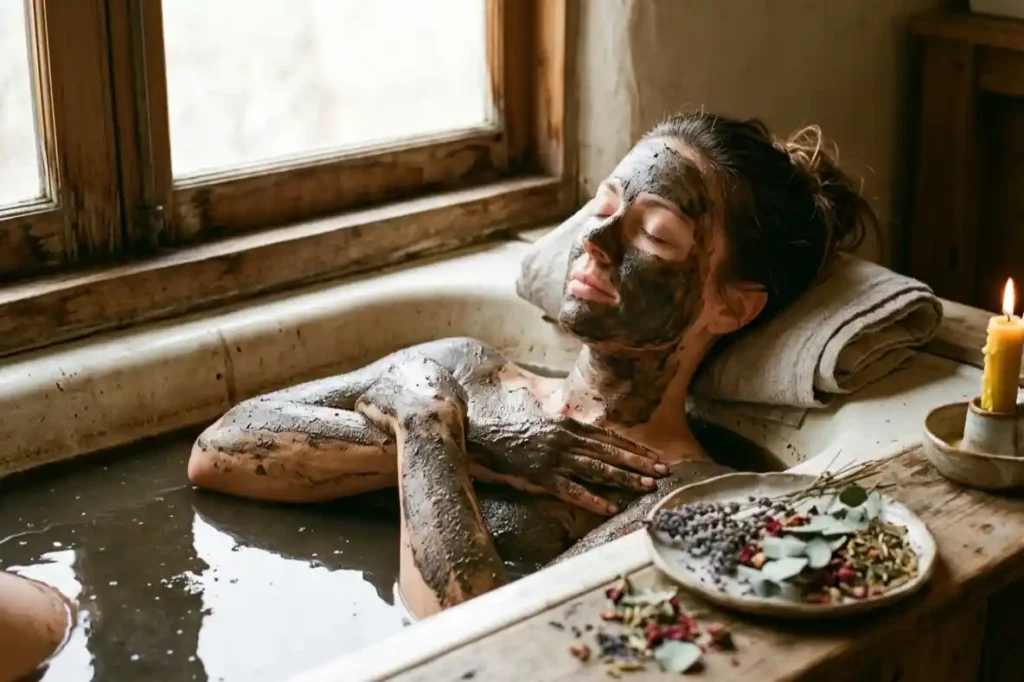
Step 3. Apply or soak. Spread and lie still for 15 to 20 minutes on a covered surface, or dissolve into a warm bath and submerge for the same window.
Step 4. Rinse thoroughly. Warm water and a cloth. Use a drain screen with any grain-heavy muds.
Step 5. Moisturise immediately. Drawing clays remove moisture alongside impurities. Body oil applied straight after the rinse seals in what the mud cleared space for. This step is not optional.
Step 6. Rest for 20 to 30 minutes with water nearby. The full physiological effect builds during rest. People who skip this consistently get half the experience and cannot understand why.
Safety note: Avoid mud baths if you have open wounds, a heart condition, high blood pressure, or are pregnant. Patch test any new material before full application.
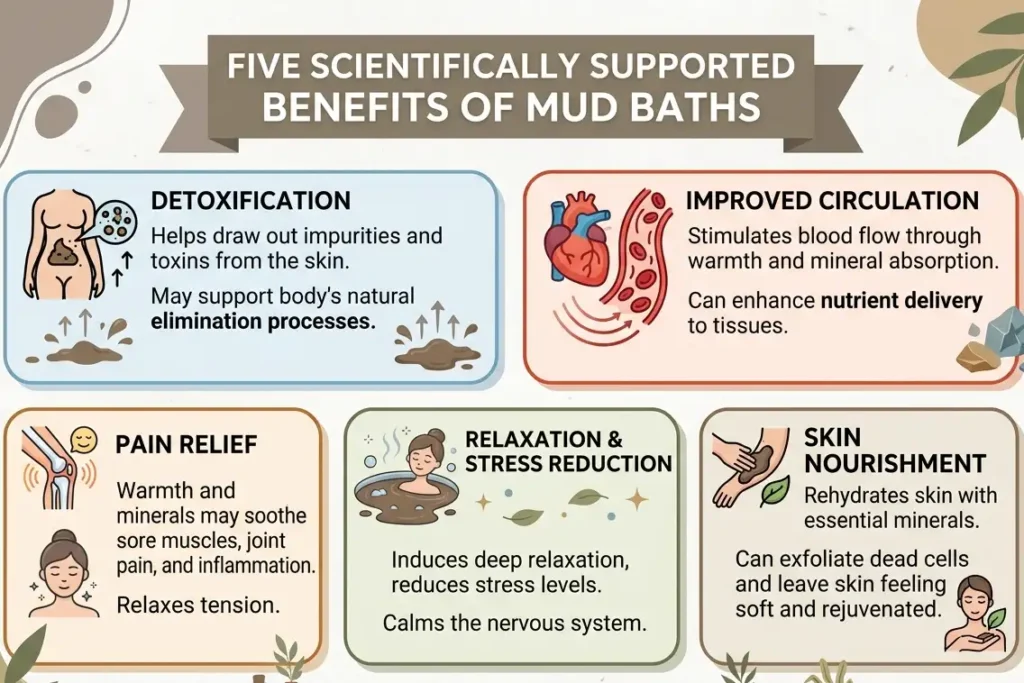
What the Evidence Actually Supports
Ionic skin detoxification is the most consistently demonstrated mechanism across clay research. It is electrochemistry, not wellness copy. What this means specifically for your skin is covered properly in Mud Bath for Skin: Detox, Glow and Heal Naturally.
Improved circulation from warmth combined with mineral absorption. Magnesium and vasodilatory minerals support blood vessel function. The flushed, luminous appearance after a good mud bath is a real physiological response.
Muscle and joint pain relief has clinical backing within balneotherapy research, particularly for moor mud applied to musculoskeletal conditions. If physical reset is your primary goal, Mud Bath Detox: Body Cleanse and Energy Reset covers the full approach.
Deep relaxation is physiologically documented. Warmth, weight, and deliberate pace create a measurable parasympathetic nervous system response. Your body shifts into rest mode. That is biology.
The Mistakes That Ruin Mud Baths
Using garden soil. Therapeutic mud is defined by mineral composition, not by being wet and earthy. Regular soil does not carry the required ionic charge and may contain bacteria and contaminants.
Metal utensils with bentonite. Neutralises the clay’s ionic charge entirely before it touches your skin. Wooden tools only, without exception.
Leaving mud on past the active window. The active phase ends when the clay fully dries. Beyond 20 to 25 minutes, you are increasing irritation risk, not deepening the effect.
Skipping moisturiser. Drawing clays take moisture with them. Replenishing immediately after is part of the ritual, not an optional extra you do if you remember.
Water that is too hot. Mud holds and amplifies heat. Very hot water in a mud bath causes dizziness faster than a plain bath. Warm is correct. Scalding is not.
Ready to Experience the Real Thing?
Reading about mud is one thing. Feeling what the right material does to your body in a properly led session is something else entirely.
At Maya Sacred, James leads mud ritual experiences across the UK and in Ibiza for people at every stage of their wellness journey, from complete beginners to those looking to go deeper with their earth-based practice. Every session is built around your skin type, your physical needs, and your intention for that day.
If you want to know which mud is genuinely right for you before you buy anything, come to a session and find out firsthand.
Browse our Sacred Rituals and upcoming events at mayasacred.com/sacred-rituals
Or if you want to start building your own mud ritual at home with materials we have personally sourced and use in our own sessions, explore the Maya Sacred Sacred Collection for everything you need in one place.
The mud is ready. The only question is which one is right for you.